Yoga Vasistha is known for its dense symbolism, repetitive themes, and philosophical storytelling. It often revisits the ideas of:
- Ego dissolution
- Mind as illusion
- Consciousness as the ultimate reality
- Liberation through detachment and insight
The text is rich in allegory, where many characters and stories are symbolic representations of inner psychological or spiritual states. To get an example of this see this link on the Symbolism of Mahabharat.
I was given this book in 2005 and would read parts of it as recommended by Sukhiji as the stories are very deep. It’s now 2025 and I wanted to finish it as I’d stopped reading it for a while. This is not recommended as it’s just so very repetitive and I had to plough through more than half the book.
Video talk by Sukhiji of Art of Living
Self-effort of 2 categories past and present birth, the one which is stronger wins, so no fate or outside agency made it happen apart from self-effort which is another word for divine will. This will have 3-fold root and fruit of inner awakening in intelligence, decision in mind & physical action. Encourage the pure tendencies and the disuse of impure ones will weaken, then you will have to abandon the good tendencies after overcoming the evil ones. (Paras note: I call this the seesaw of duality)
4 gatekeepers of moksha are self-control, spirit of enquiry, contentment & good company. Just conquer one and the rest will follow.
Object exists in the subject like bracelet in gold.
Truth is in the middle between real and unreal.
Even in the book they have Indian sound effects like khut-khut, tuk-tuk and jhun-jhun.
The worst sinners can be born as trees, middle sinners as worms and animals, light sinners as humans. The best righteous are in heaven or born to good and affluent families, middle righteous come as children of bhramanas, light righteous pass through realms as demigods to suffer a bit.
The power (chit sakti) also known as mahasatta (the great existence), mahaciti (the great intelligence), mahasakti (the great power ), mahadrsti (the great vision), mahakriya (the great doer or doing), mahodbhava (the great becoming), mahaspanda (the great vibration) – is the power that endows everything with its characteristic quality.
The mind is everything. If one masters mind, everything is mastered. One who does not allow his mind to roam in objects of pleasure is able to master it. There is no other path to one’s salvation.
When the same mind is devoted to enquiry and wisdom, it shakes off all conditioning and returns to its original nature as pure consciousness.
7 descending steps to ignorance. Seed state of wakefulness, wakefulness, great wakefulness, wakeful dream, dream, dream wakefulness, sleep.
7 ascending steps of wisdom. Pure wish/intention, enquiry, when mind becomes subtle, establishment in truth, total freedom from attachment/bondage, cessation of objectivity, 7th is beyond all these.
Ego makes you mortal, dissolving the I, you will be immortal. Free from dualities and getting rid of the mind’s violent son (doubt) and its wife (craving).
This manifestation of the omnipotence of infinite consciousness enters into an alliance with time, space and causation which are indispensable to the manifestation. Thence arose the infinite names and forms. But all these apparent manifestations are in reality non-different from the infinite consciousness. That aspect of this infinite consciousness which relates itself to the manifestation of the names and forms and thus to time, space and causation is known as the ‘knower of the field’, or the witness consciousness. The body is the field; that which knows this field inside out and in all its aspects is the knower of the field or witness consciousness. This witness consciousness becomes involved in the latent predispositions and develops the ego-sense. When this ego-sense generates notions and intentions within itself, it is known as the intellect. As the thinking instrument, it is known as the mind. When the intelligence gets further modified or perverted, it becomes the senses. All of these constitute the body. Just as a fruit undergoes various changes in size, colour, etc., as it matures, the same consciousness undergoes these apparent changes as the ignorance grows deeper and denser. The foolish person then abandons all right thinking or enquiry into the truth and voluntarily embraces ignorance as bliss. Caught in its own trap of various activities, and of identification of oneself as their doer, he undergoes endless suffering which is self-imposed and self-willed. O Rama, in this world the cause of all misfortunes is only the mind which is full of sorrow and grief, desire and delusion. Forgetful of self-knowledge, it generates desire and anger, evil thoughts and cravings which throw the person into the fire of sense-objects. O Rama, rescue this mind from the mire of ignorance.
The infinite consciousness which is devoid of time, space and causation playfully assumes these. Thus the cosmic person comes into being; this cosmic person is also the cosmic mind and cosmic life. This cosmic person intends to experience sound; and space is brought into being, with the transmission of sound as its character. It intends to experience touch; air is created. These are unseen and subtle. Wishing to see, this cosmic person brings fire into being, and this fire expands into the numerous sources of light. It intends to experience taste as well as coolness to counteract fire; water comes into being. And, lastly, by its mere wish to smell, earth with its faculty of smell comes into being. This cosmic person with all its faculties is still extremely subtle and undivided. It apparently abandons that and perceives itself as infinite sparks in space. It thinks of itself as each one of these sparks; the ego-sense arises. This ego-sense also has intelligence inherent in it, and it conceives of a body for itself with the help of the five cosmic elements I have already mentioned. This body it regards as gross, physical and material, and so it becomes. This cosmic person is the Brahma. He appears to create all these countless beings; and he himself protects them. He first arose in the infinite consciousness: but apparently overcome by self-limitation and forgetfulness of the infinite nature, as in foetal sleep, he identifies himself with the body, fuelled and maintained by the life-force (prana) and composed of material substances. When he begins to enquire into his origin, his true nature is revealed to him; and he is liberated from self-limitation.
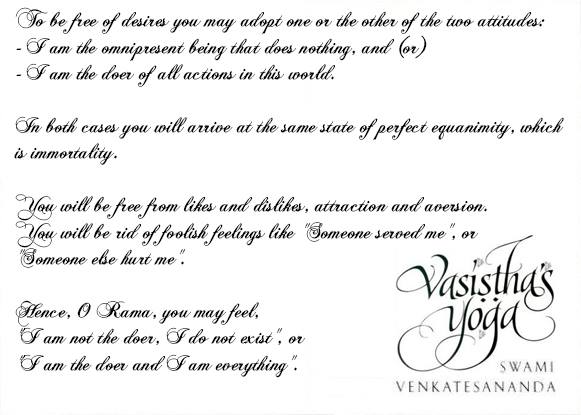
You may adopt one or the other of the two attitudes:
(1) I am the omnipresent being that does nothing, and
(2) I am the doer of all actions in this world. In both cases you will arrive at the same state of perfect equanimity, which is immortality.
The life force is restrained by the following means: by dispassion, by the practice of pranayama (breath control) or by the practice of enquiry into the cause of the movement of the life force, by the ending of sorrow through intelligent means and by the direct knowledge or experience of the supreme truth.
This mind is inert and is not a real entity: hence it is for ever dead! Yet, beings in this world are killed by this dead thing: how mysterious is this stupidity!! The mind has no self, no body, no support and no form; yet, by this mind is everything consumed in this world.
Whatever terrible sufferings and calamity there are in the world are all the fruits of craving, O Rama. First, let the images of ‘I’, ‘you’ and ‘this’ not arise in the mind, for it is because of these images that hopes and expectations come into being.
2 kinds: One based on knowledge or direct realisation and the other is based on contemplation. Become aware of the notions ‘I belong to these objects of the world and my life depends upon them. I cannot live without them and they cannot exist without me, either’. Then by profound enquiry, one contemplates ‘I do not belong to these objects, nor do these objects belong to me’. Thus abandoning the ego-sense through intense contemplation, one should playfully engage oneself in the actions that happen naturally, but with the heart and mind ever cool and tranquil. Such is known contemplative egoless ness.
When there is knowledge or direct experiene of the non-dual truth, one abandons the ego-sense and conditioning, and entertains no feelings of ‘This is mine’ even with regard to the body – this is known as direct realisation of egolessness.
He is liberated even while living who playfully abandons the ego-sense throught the contemplative method. He is considered a liberated sage who is not swayed by the desirables and the undesirable, who lives in this world and functions though inwardly totally untouched by the world, as if he is in deep sleep.
When dispassion matures, the spirit of enquiry arises in oneself. The spirit of enquiry strengthens dispassion. These two are interdependent, even as the ocean and the clouds are.
He who has nothing but has this self-knowledge has everything. He who abandons this and seeks other things is not a man of wisdom.
Abandon Vanity, anger, impurity and violence: for great souls are not overcome by such baseless qualities. Remember past sorrows again and again; and with cheerful attitude of mind enquire “who am I? “, “How could all this happen?“ and be free from all that.
There is a part in a book which says “all this practised without the violence involved in Hatha Yoga for Hatha Yoga gives rise to pain”.
Includes Lord Krishna’s chat with Arjuna, which is chronologically incorrect but Ramayana is used as a framework and this book is much newer compared to Ramayana and Mahabharat.
It has a story of a vampire and a sage from outer space!
Total dedication to one thing, restraint of prana and the cessation of the mind – if one of these three is perfected, one attains the supreme state.
Explanation of kundalini, breathing and health issues are touched on in The story of the Sikhidhvaja and Cudala.
Individuality exists only as long as desire for pleasure lasts.
Here’s a sentence – I shall narrate a parable, hearing which you will become enlightened even if you are already enlightened!
I can’t remember how many times the metaphor of the coconut and the crow has been repeated. Used to explore the nature of causality, coincidence and divine play (lila).
Special thanks to Meera Madiabs for getting me this book.
Hey folks, it’s Paras!
If you have a request to see a tech product, summary on personal development or want a custom design for clothing and merch … Please do let me know through the links below.

Join me or support my work
🎤 Podcasts: My Stories | Self Growth
💌 Monthly email summary
▶️ YouTube | TikTok | Instagram
👍 Facebook | X | Blog
Other links:
💰Get $25 of FREE Bitcoin
☕ Buy me a Coffee
🛒 My Amazon |👕 My Merch
🏫 Join Skool


