
The Psychology of Persuasion – Robert Cialdini
So far one of the best books I’ve read and I recommend it to everyone that can read! All the choices you think you have made have been influenced, at some percentage. ALL your choices… until you read this book. I love case studies and this book is full of them. Each chapter begins with an advertisement and at the end you’re asked to discuss how the content of the chapter related to the advert. Every chapter ends with a few ways to defend yourselves against the influence. The chapters also end with a summary and Study Questions. Big up Ameet for hooking me up and big up David Deangelo for suggesting it.


Notes
Chapter 1 – Weapons of Influence
– Mother turkey started nursing a stuffed polecat just because a recorded baby turkey cheep-cheep was heard from it. Same way for humans the word ‘because’ was the trigger. E.g. can I cut in line to make photocopies didn’t work but can I cut in line because I’m in a rush worked. Note: After using because it does not matter how valid your excuse it.
– A fridge was left outside the house saying ‘free to anyone that wants it’. It wasn’t taken until they owners changed free to a price and it was stolen immediately. Expensive = good so sometimes hiking up the price of something not selling will help. Even adding ‘reduced’ to an item.
– Folks that don’t know betting usually bet on whatever is being bet on most so clever pros bet lots on a losing one earlier to change the odds and then switch to claim their winnings.
– If an expert said so, it must be true. (Sometimes dangerous like in the flight case study where the first officer didn’t question the captain).
– Rove beetles release a scent that makes certain ants think the beetles are their young so the rove beetle stays with them while they get groomed and even eating the rest of the ant eggs.
– Sales persons ask the boss for a price… pretend to mishear and say something cheaper. Another one is where they sell you the expensive stuff first so first the suit, then in contrast the shirt and tie to go with it will sound cheaper. Or like a house salesman would have 1-2 undesirable houses (setup properties) to show the buyer first. Car sales people do this by giving a low number then slowly adding the price little by little for say CD player, better tyres, upholstery etc.
Chapter 2 – Reciprocation: The Old Give and Take … and Take
– Reciprocation and how that has lead to such a strong bond between Mexico and Ethiopia… out of all places! Best example is how Hare Krishna folks give you a flower or free hug… something is triggered inside to reciprocate (on top of that they knew the flowers would be thrown in the bin so every now and then one would go to the bins and recollect the gift to give someone else). It’s so powerful even the people that don’t like the other can still be influenced. Another e.g. is free samples in the supermarket.
– German soldiers were disarmed when they catch the enemy off guard eating and when caught unawares the enemy simply gestured to offer the German the bread.
– Once the reciprocation cycle is started the one in debt can feel the burden and the one that gave can have resentment for the one that does not reciprocate… with a few exceptions like long-term relationships (established friendships and families etc).
– Reciprocal concessions are another one. Say a kid knocks on your door asking you to buy tickets for some thing and you say no. Then his concession would be if not the $5 tickets how about some of our $1 chocolates? So make a larger request first and after it’s refused you make your originally intended request. The larger the initial request the easier… up to a point then you’re just being ridiculous.
– Sales people then try to get referrals from you so when they call your friends or family, it’s under the mask of being a friend or recommendation from someone you trust. More later, it was just mentioned as a sales tactic is to get rejected on the first pitch to reduce your offer to asking for referrals.
Chapter 3 – Commitment and Consistency: Hobgoblins of the Mind
– Once we make a choice or take a stand, we will encounter personal and interpersonal pressures to behave consistently with that commitment. Most true with lovers when they both know it’s not going anywhere or can’t stand each other.
– Sometimes this consistency is mechanical because we’re comfortable not doing all the calculations and avoid the labor of thinking.
– A way to keep sales up after Christmas was to have the ‘in demand’ toys in limited supply so parents are forced to buy the kid something else but since the kid was expecting the ‘in demand’ toy the parent promises to get it soon as it’s back in stock. Which is after the festive season. Going to the store and seeing the other parents want the same thing makes it more valuable. Sometimes folks pay 10 times more to get it before the others.
– Beware of just simple questions like would you volunteer for so and so if you had to or were needed to. Not that they’ll pressure you into it on the first meeting… but in the next call or drop in they’ll bring it up and since you said you would you want to look consistent. This is how they increased volunteers by 700%.
– Another trap is them asking you how you’re feeling. Because once you say good you’re in a better position than the cause they’re calling for and thus subtly feel obliged or guilted into it.
– The Chinese used this so well against American POWs with their leniency. They started small and built. E.g. 1 – Asking the POW to make anti-American/pro-Communist statements like “The US is not perfect”. Small start but they’re in now. 2 – Then they’d ask how the US was not perfect. 3 – Then they write about it (very powerful). 4 – Then broadcast the essay on radio etc. 5 – The other POWs would hear this. Up to a point where they’d say stuff like “although communism won’t work in America, I think it’s a good thing for Asia”. More on this in coming chapters.
– Foot in the door techniques by sales people. Start small. Case study of how locals were first asked just to allow a sign of safe driving at their homes. Once the residents felt like they’re playing their part in maintaining the local community the stakes were raised to signing a petition to keep the area clean. And so on.
– Having a POW write out the question and then the pro-Communist answer. If he refused to write it voluntarily, he was asked to copy it from the notebooks, which must have seemed like a harmless enough concession. (So it’s in his own handwriting as a lasting personal reminder and it can be shown to others).
– Something we learn in AOL is to praise the person with the qualities you want to see in them e.g. President Anwar Sadat would flatter their opponents by stating how they and the citizen were widely known for their cooperativeness and fairness.
– POW who wanted to let their family know they’re ok knew to get their letters through they had to write good stuff about the captors like fair treatment or intentions of peace and surrender etc. Then there was the assay one where they’d win either a few cigarettes or fruit. See they were given just a little fruit or cigs so when writing the essay it was less about winning the small reward and psychologically more about them really believing in what they write. Which is why bribing children works for only so long.
– So sales people are asked to set a goal and write it down… which is nothing new these days.
– To combat the ‘cooling-off’ law that helps customers cancel if they have second thoughts the companies get you on paper. Proctor and Gamble used an essay competition that went something like … I like the product because …
– A test was done where folks wrote down a belief on a magic pad which means they could erase the evidence but still they stayed committed to the belief. It’s worked for folks wanting to stop smoking, lose weight, etc.
– Changing ‘Please call us if you change your plans’ to ‘Will you please call us if you change your plans?’ immediately switched the no-show rate by 20% in restaurants.
– If you see ads for concerts or the like and they don’t show a price, it’s because they want you to call in or visit the website so once you’re committed that much… they got you!
– Hazing! Fraternities haze you by hell week, beatings, exposure to cold, thirst… some kind of ordeal… why? Because after that you’ll be so much more committed to the club/cult/etc. Gang members get the shit beat out of them. Masons initiations. Tribes do it… it happens everywhere and after you do it… your commitment is solidified. The more pain and effort you go through to get something, the more you value it. And the funny thing is when folks tried to ban the initiations, the trials become more harsher and more secret or there were riots to keep the initiations as they were… even if it cost lives or health etc.
– Kids were threatened not to play with a toy then observed from a one-way mirror… they didn’t play with the toy. But six weeks later when they were given the toys to choose the played with the forbidden one since the threat was no more there. In a similar experiment kids where just told it’s wrong to play with the toy and they didn’t play with it and 6 weeks only 33% played with the forbidden toy. (Paras note: No wonder I did all the things I was threatened not to do ;oP). So there are 3 kinds of kids to know which one of these lines to use 1 – it’s bad to like, honey, so I hope you won’t do it, 2 – because if you do, I’ll be disappointed in you, 3 – I’ll probably have to do something I don’t want to do. Samuel Butler said ‘He who agrees against his will / Is of the same opinion still’.
– Growing legs: Example – car salesmen lowballing. They give you a very low price so you’re happy with it. Then they let you marinate that thought till it grows it’s own legs to support your reason for buying after letting you have the car to drive for the day… slowly he’ll say for a little fee of this much you can get matching trimmings etc. Or they say they salesperson forgot to add cost of air-conditioning and mp3 player etc. Sometimes they do it in a way that makes you feel guilty for getting such a good price and not saying nothing about it. So once you grow your own legs to support your choice they pull the leg they gave you and let you grow more of your own. Attendance e.g. Asking students to attend something at 7 a.m. They were asked if they will attend and after getting a yes telling them the time. Boyfriend e.g. Guy says he’ll change for her if only she takes him back. He does change but only for a couple of months and goes back to his routine. But she loves him more than ever because it was her choice and she’s committed to it. Energy saving e.g. Publicising names of ‘public-spirited, fuel conserving citizens’ helped more than just telling them how much they would save. So once the citizens got in on the action, they grew their own legs of enhanced self-esteem, new self-image, lowered energy bill, need to reduce foreign oil dependency… and the publicity leg was knocked off/low balled.
– Defence: Listen to your stomach, let the person know you know what they’re doing. Another way is asking yourself ‘knowing what I know now, if I could go back in time, would I make the same choice?’.
Hey folks, it’s Paras!
If you have a request to see a tech product, summary on personal development or want a custom design for clothing and merch … Please do let me know through the links below.

Join me or support my work
🎤 Podcasts: My Stories | Self Growth
💌 Monthly email summary
▶️ YouTube | TikTok | Instagram
👍 Facebook | X | Blog
Other links:
💰Get $25 of FREE Bitcoin
☕ Buy me a Coffee
🛒 My Amazon |👕 My Merch
🏫 Join Skool
Chapter 4 – Social Proof: Truths Are Us
– Canned laughter like on sitcoms and how it’s effective because of social proof. People laughed longer and more frequently when recorded laughter was played with the sitcom which is why they have it now, especially on poor jokes. Follow the crowd mentality. Bartenders ‘salt’ the tipping jar the same way to get more tips if people see there is already some money in there. Evangelists have ringers in the audience to come at specified times to give witness. Adverts use ‘fast growing or largest selling’ to let people know how many other people have already bought it. If used in the right way it can be used in say, when a kid is scared of dogs and then the kid sees friends or same aged kids playing with dogs. (Remember that joke where you keep looking at the sky till there is a crowd with you looking at the sky while you sneak off?)
– Crazy story of how one cult believed the end of the world was coming and they all gathered waiting for their rescue spaceship. But it didn’t come so the leader and his ‘automatic writing’ say that ‘the little groupe, sitting alone all night long, had spread so much light that God had saved the world from destruction’. Before they had all these codes and only few people were allowed. Now they realise it was not coming their commitment solidified even more by calling and trying to recruit more people even though nobody joined. They even went to the media.
– Pluralistic ignorance: failure of an entire group of bystanders to aid victims in agonising need of help. Catherine Genovese story – 38 witnesses saw or heard the attack but did nothing.
– Remedies: First make sure people around you know you need HELP! Second let them know what kind of help (call an ambulance, etc.). And most effective is if you point out to a specific person. ‘You in the white jacket, I need help, call the ambulance’.
– Just remember when people are uncertain they are going to copy the people around them and people like them. Another kid example: Kid couldn’t swim and mom got coaches etc. but nothing helped until kid went to a camp and saw Tommy, also 3 year old, so kid started too.
– Werther effect: When there is a suicide on the news. People of the same age and same area has an increase in suicide rate. And it’s not only suicide. Like how the Jonestown suicides worked. But setting is also important and because Jim Jones not only had charisma but he also convinced his sheep to follow him from San Francisco.
– Now you know what adverts are about when you see average Joe or Jane hyping the product. And beware of audience claques too. They’re paid and even have a price list for costs like applause, insistent applause, ‘bravo’, ‘encore’, etc. Basically check your autopilot now and then. Like folks that bet on horses sometimes put a high bet on a loser so folks will bet on that so once the odds have changed he bets on the winner.
– Defence: Since we’re faced with so many choices every minute of the day we can’t always be on guard so the best defence is to be aware and if you feel like this is not where you want to follow the crowd, simply disengage. (funny comic strip of pigs going to slaughter house saying ‘so much for safety in numbers’)
Chapter 5 – Liking: The Friendly Thief
– Like Tupperware parties where ladies and their friends sit and have fun and once they’re happy and all that smiley vibe… BUY BUY BUY! Tupperware parties start somewhere every 2.7 seconds.
– Sales people don’t always want to sell, sometimes they want you to reject them so they can ask for a concession like asking for a referral of a friend as the friend will think ‘yeah he’s come from a reliable source’. People prefer to say yes to folks they know and like.
– Factors for liking include: Physical attractiveness, similarity, compliments.
– Politicians change their names to a country friendly one and suddenly gets more votes.
– School desegregation increases prejudice between blacks and whites as they stick with their ‘kind’. Even a teacher asking a question can cause problems like if the teacher called upon someone that didn’t know the answer and there was a boy that knew it and really wanted to answer. Or even the clever vs. the dumb or clever kids that don’t answer to look cool etc. But ‘cooperative learning’ schools do so much better. E.g. of an experiment of kids in a camp, two teams got very competitive, but when both faced the same problem, they quickly got together to solve the problems. This way dummies are helped by smarties. Cops use this in the good cop bad cop situation. Good looking models on car adverts. Restaurants that have credit card accepted signs get lot more business even when credit cards were not used for paying! Mars landing helped Mars chocolate business. Celebrities wearing company logos and endorsing products. Even politicians hang with celebrities to make them look cooler.
– People who give bad news are treated like they’re the ones that did it. Like weather men getting death threats or old ladies hitting him with bags etc. When someone has to give good news they can go into detail about it but when they have to give bad news they’ll be more like ‘you should talk to your dad or teacher about it’. Even in sports, supporters will be like we’re winning or we’re number 1 but when it’s a bad thing it’s they fouled, they were so useless today.
– Does the name Pavlov ring a bell? ;) Well people use luncheons too because after eating liking is increased.
– Defence: Again you can’t be vigilant with everyone so best defence is realising when you like someone too much too fast. In the 25 minutes I’ve known this person, have I come to like them too much? If the answer is yes, then mentally separate your liking for the person from their offer.
Chapter 6 – Authority: Directed Deference
– Authority figures are more respected and listened to/relied on. Example: shock treatment from a fake person in a coat telling some random guy to shock another random guy increasingly as he gets questions wrong. Random guy would resist but the coat guy would be like go ahead and random guy would go ahead. Even when random guy 2 was pleading to be let out and that he’s got a heart condition and random guy 1 was so conflicted and even biting their own lips not wanting to go ahead!
– Funny story of ear doctor giving prescription to be given in the right ear or R. ear and the chemist read it as ‘rear’ so the nurse put required number of drops in the anus.
– Larry Kings voice style changes when he’s interviewing Cliton or Striesand but it’s unmoved when guests are of lower status. Even lower status monkeys given caramel spread, the liking for caramel spread to only 51% in 1.5 years and none of the leaders, but when the leaders had some and it spread 100% in 4 hours. Again, celebrities and adverts link to this.
– Symbols of authority are: Titles, clothes and trappings (as in car and such).
– Authority: When a doctor introduces himself without saying he’s a doctor the conversation is more fun and gets more serious when he says he’s a doc. The higher your status the higher people perceive your height like someone introduced as just a student ‘seemed’ shorter by 2.5 inches than when he was introduced to another crowd as a professor. So for personal ad’s men saying they’re tall and women saying they’re short or weighed less got more responses. Experiment where nurses got calls from someone saying he was a doctor and how they blindly followed and broke 4 crucial rules.
– Clothing: Classic cases like fake folks dressed as cops giving orders. Did you know you’re more likely to follow someone wearing a suit that crosses the road when the don’t walk light is on?
– Trappings: Jewellery, watch, car etc. You’re likely to take longer to honk at someone with a nicer car.
– Then also beware of sly sincerity. E.g. Listerine, the stuff you hate 3 times a day. Avis, we’re number two, but we try harder. L’Oreal, a bit more expensive but worth it.
– Like this waiter that had a repertoire of approaches depending on if it’s a family, couple etc. With family he was more friendly and clownish with the kids. With couples he was more formal and only talked to the guy. Alone guys got cordial, conversational and warm. His one trick was to frown and look over his shoulder and then secretly say this dish is not all that can I recommend this or that which were less expensive too. After getting the food order he’d ask if he could choose the wine and the customers already trusted him and he’s on our side etc. so they’d agree and he get them to buy expensive wines. When it was dessert time he would give them amazing descriptions.
– Defence: Awareness and ability to identify fakes. Asking your self ‘Is this authority really an expert?’ and then ‘How truthful can we expect this expert to be?’
Chapter 7 – Scarcity: The Rule of the Few
– Scarcity. Less is best, loss is worst. Like when students rated cafeteria food low and when they found out that because of a fire they wouldn’t get some for 2 weeks that liked it more. You want things you can’t have or are in demand. More value when something is less available.
– Telling customers ‘I think that was the last one’ or ‘We wont be making it with these engines and more’. Limited time offers. I have so many people to see and wont be able to come back if you change your mind. Paras note: Every gym I’ve joined has got that only today offer.
– Story of children at 2 and how you tell them don’t do this and they do this. If you give them one toy they want the other. How they went for the toy that was behind a big obstacle instead of a short barrier. Even teenagers are in this state. Like when parents forbid them to see a certain someone and they end up loving that forbidden person. When interference weakened the feelings cooled down. But it applies to us all as we feel if our freedoms are going to be taken away or in threat, we’ll do something about it.
– In censorship, those that learned of the age restriction wanted to read it and felt they would like it more.
– So if something is scarce you want it more but you want it even more when it’s classified/exclusive information or information that lets you know that only a few people will get the scarce stuff.
– Major revolutions, revolts and internal wars occurred because of this. Like when slaves did what they were told. Then they got rights, schooling, housing, employment, etc. and when that came under threat, things went down! Or when Mikhail Gorbachev granted freedoms and the KGB put him on house arrest the population thought it was a threat to their freedoms and the uprising was so swift, strong and unitary that after 3 days, it went back to Gorbachev. Or when coupons were discontinued even when the population wasn’t using them. Or salespeople telling fence-sitters that they’re already with someone viewing the house. Or a car salesman telling people to come see the car at the same time and then make the late comers wait and watch him showing of the car to the early birds.
– Defence: Once you get into competition or get emotional about winning the thing it’s hard to get logical so first you get the awareness that you’re ‘tide is rising’ in this area. Then think if this item is really worth all that effort, time and money. So in a situation you feel your tide of emotion making you want the item more or win it over some competition, think about if you really need it that bad and if that price is worth it.
Chapter 8 – Instant Influence: Primitive Consent for an Automatic Age
– TV host tells Zappa ‘I guess your long hair makes you a girl’. Zappa replies ‘I guess your wooden leg makes you a table’.
– Talks about how we rely on a single feature to decide about someone. With our fast paced life we need this shortcut. Modern automaticity. How with all that info sometimes we end up worse off than lower animals as we don’t have time to digest the information. Faked ‘unrehearsed interviews’. How night clubs say house full when it’s empty to create a queue to make the club look popular.
– Talks about why we should retaliate when we see this and know what the real deal is.
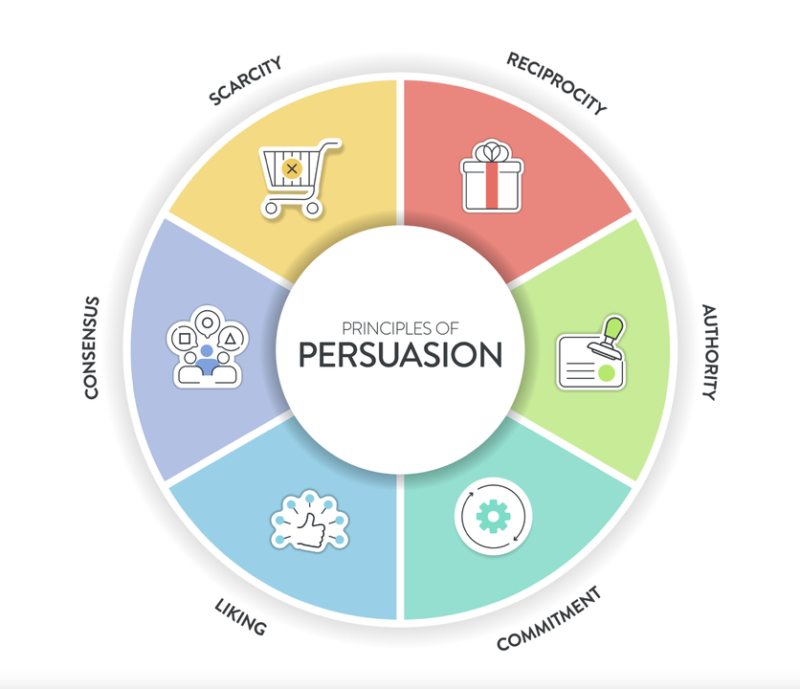
Defenses Against Each Influence Principle (Summary List)
1. Reciprocity
Defense:
- Recognize when a “gift” or favour is meant to create a feeling of obligation.
- Reframe the situation: a gift given to manipulate is not a true gift.
- Accept the gift if you want, but reject the obligation.
2. Commitment & Consistency
Defense:
- Ask yourself: “Would I make this choice again if I were starting from zero?”
- Notice when a small initial commitment is being leveraged to force a bigger one.
- Avoid automatic “consistency” responses – pause and reassess.
3. Social Proof
Defense:
- Check whether the crowd actually knows something – or is simply reacting.
- Look for real evidence, not just popularity.
- Be especially cautious in uncertain or ambiguous situations (where social proof is strongest).
4. Liking
Defense:
- Separate the message from the messenger.
- Ask: “Would I agree to this if I didn’t like this person?”
- Watch for liking triggers: attractiveness, similarity, compliments, familiarity.
5. Authority
Defense:
- Verify two key things:
- Is the authority real? (Credentials, expertise.)
- Is the authority trustworthy? (Are they honest, unbiased?)
- Notice symbols of authority (title, clothing, status markers) and don’t let them override thinking.
6. Scarcity
Defense:
- Ask: “Would I want this if it weren’t scarce?”
- Recognise when urgency or limited availability is artificially manufactured. (The Power of Saying NO – Quotes and Ways to Say No)
- Focus on value, not fear of missing out.
7. Unity (added in later editions)
Defense:
- Notice when someone is trying to manufacture a sense of “we’re the same group.”
- Ask whether the shared identity is genuine or just a persuasion tactic.
- Don’t let tribal closeness override critical thinking.
8. Instant Influence
Defense:
- Audit Your Environment: Recognize that we often use single pieces of information (like a price tag or a celebrity endorsement) to make quick decisions. Be aware when you are “low on bandwidth” (tired, rushed or distracted).
- Identify Manipulated Shortcuts: Distinguish between naturally occurring shortcuts and those artificially manufactured by “compliance professionals.”
- Aggressive Counter-Attack: We should not just ignore, but actively boycott or retaliate against those who purposefully fake or “poison” our mental shortcuts (e.g., staged “man on the street” testimonials).
- Demand High-Quality Data: When the stakes are high, force yourself to slow down and look for a second or third source of information rather than relying on a single, easy-to-grab cue.
Hey folks, it’s Paras!
If you have a request to see a tech product, summary on personal development or want a custom design for clothing and merch … Please do let me know through the links below.
Join me or support my work
🎤 Podcasts: My Stories | Self Growth
💌 Monthly email summary
▶️ YouTube | TikTok | Instagram
👍 Facebook | X | Blog
Other links:
💰Get $25 of FREE Bitcoin
☕ Buy me a Coffee
🛒 My Amazon |👕 My Merch
🏫 Join Skool
Hey folks, it’s Paras!
If you have a request to see a tech product, summary on personal development or want a custom design for clothing and merch … Please do let me know through the links below.
Join me or support my work
🎤 Podcasts: My Stories | Self Growth
💌 Monthly email summary
▶️ YouTube | TikTok | Instagram
👍 Facebook | X | Blog
Other links:
💰Get $25 of FREE Bitcoin
☕ Buy me a Coffee
🛒 My Amazon |👕 My Merch
🏫 Join Skool
Contents
– Preface
– Introduction
Chapter 1 – Weapons of Influence
Click, Whirr
Betting the Shortcut Odds
The Profiteers
Jujitsu
Summary
Study Questions
Chapter 2 – Reciprocation: The Old Give and Take … and Take
How the Rule Works
The Rule Is Overpowering
Politics
The Not-So-Free Sample
The Rule Enforces Uninvited Debts
The Rule Can Trigger Unequal Exchanges
Reciprocation Concessions
Rejection-Then-Retreat
Reciprocal Concessions, Perceptual Contrast, and the Watergate Mystery
Damned If You Do, Damned If You Don’t
Here’s My Blood, and Do Call Again
The Sweet, Secret Side Effects
Responsibility
Satisfaction
Defence
Rejecting the Rule
Smoking Out the Enemy
Summary
Study Questions
Chapter 3 – Commitment and Consistency: Hobgoblins of the Mind
Whirring Along
The Quick Fix
The Foolish Fortress
Seek and Hide
Commitment Is The Key
Hearts and Minds
The Magic Act
The Public Eye
The Effort Extra
The Inner Choice
Growing Legs to Stand On
Standing Up for the Public Good
Defence
Stomach Signs
Heart-of-Hearts Signs
Summary
Study Questions
Chapter 4 – Social Proof: Truths Are Us
The Principle of Social Proof
People Power
After the Deluge
Cause of Death: Uncertain(ty)
A Scientific Approach
Devictimizing yourself
Monkey Me, Monkey Do
Monkey Die
Monkey Island
Defence
Sabotage
Looking Up
Summary
Study Questions
Chapter 5 – Liking: The Friendly Thief
Making Friends to Influence People
Why Do I Like You? Let Me List the Reasons
Physical Attractiveness
Similarity
Compliments
Contact and Cooperation
Off to Camp
Back to School
Conditioning and Association
Does the Name Pavlov Ring a Bell?
From the News and Weather to the Sports
Defence
Summary
Study Questions
Chapter 6 – Authority: Directed Deference
The Power of Authority Pressure
The Allures and Dangers of Blind Obedience
Connotation Not Content
Titles
Clothes
Trappings
Defence
Authoritative Authority
Sly Sincerity
Summary
Study Questions
Chapter 7 – Scarcity: The Rule of the Few
Less is Best and Loss is Worst
Limited Numbers
Time Limits
Psychological Reactance
Adult Reactance: Love, Guns, and Suds
Censorship
Optimal Conditions
New Scarcity: Costlier Cookies and Civil Conflict
Competition for Scarce Resources: Foolish Fury
Defence
Summary
Study Questions
Chapter 8 – Instant Influence: Primitive Consent for an Automatic Age
Primitive Automaticity
Modern Automaticity
Shortcuts Shall be Sacred
Summary
Study Questions
References
Index


Great post! Love it and continue to do a good job.
thanks to the author for taking his time on this one.
Im impressed, I ought to say. Extremely rarely do I come across a weblog thats each informative and entertaining, and let me tell you, youve hit the nail on the head. Your blog is important; the problem is some thing that not sufficient men and women are talking intelligently about. Im truly happy that I stumbled across this in my search for some thing relating to this problem.
Iím not that much of a online reader to be honest but your blogs really nice, keep it up! I’ll go ahead and bookmark your website to come back later on. Many thanks
It’s really a nice and helpful piece of info. I’m glad that you shared this useful info with us. Please keep us informed like this. Thanks for sharing.
It’s actually a great and useful piece of information. I’m glad that you shared this helpful info with us. Please keep us up to date like this. Thanks for sharing.
I am really impressed with your writing skills and also with the layout on your blog. Is this a paid theme or did you customize it yourself? Anyway keep up the nice quality writing, it’s rare to see a great blog like this one these days..
*Hello! I just would like to give a huge thumbs up for the great info you have here on this post. I will be coming back to your blog for more soon.
Thank you very much for your post! I am very interested in your points.
You must be a genious. I love your posts, will come back later.
Terrific, this information is exactly what I was searching for.
Oh, this is quite interesting. Actulally, I found your blog on google search. I will tell my friend about your blog later.
I am very interested in. May I ask to spoon feed the detail please?
Your post is very interesting. I’ve read your blog for few days now and I trully enjoy your blog. Thank you for your great work!
I agree with you totally. Please write more.
Two Words: BLOG HEAVEN. I have hit the motherload, praise him.:)
Great Post!! Thank you very much!
What a great article! Where can I find more information?
I think this is very important. Thanks a lot.
Thank you very much for your post! I am very interested in your points.
Nice work. You keep working on this blog please.
Its like you read my mind! You seem to know a lot about this, like you wrote the book in it or something. I think that you can do with a few pics to drive the message home a little bit, but other than that, this is fantastic blog. An excellent read. I’ll definitely be back.
I reaped reading & I must say which I i has very inspired via A New writing experience. keep up The great the office it’s ideal refreshing To observe Somebody like this you.
Very interesting, thank you for sharing!
Cool post! How much stuff did you have to look up in order to write this one? I can tell you put some work in.
Hello there, just became alert to your blog through Google, and found that it’s really informative. I am going to watch out for brussels. I’ll appreciate if you continue this in future. A lot of people will be benefited from your writing. Cheers!
You rock. So I have the say. This is a huge blog this is a very well-educated post. You’ve made my day with this.
Please keep the info flowing about this!
This is very new info for me. Author – respect!
Kudos to you! This is a really good blog here and I love your style of writing. How did you get so good at blogging?
Hey, thanks for the great article. Honestly, about five months ago I started using the internet and there is so much nonsense out there.
Very informative article.Thanks Again. Really Great.
Very neat article.Really thank you!