A. Reading
– Adult Relationship Attachment Styles
Secure Attachment Style
Those with a strong Secure Attachment Style manifest at least a number of the following traits on a regular basis:
- Higher emotional intelligence. Capable of conveying emotions appropriately and constructively.
- Capable of sending, and receiving healthy expressions of intimacy.
- Capable of drawing healthy, appropriate and reasonable boundaries when required.
- Feel secure being alone as well as with a companion.
- Tend to have a positive view of relationships and personal interactions.
- More likely to handle interpersonal difficulties in stride. Discuss issues to solve problems, rather than to attack a person.
- Resiliency in the face relational dissolution. Capable of grieving, learning, and moving on.
People with the Secure Attachment Style are not perfect. They too have ups and downs like everyone else, and can become upset if provoked. Having said this, their overall mature approach to relationships makes this the healthiest of the four adult attachment styles.
Anxious-Preoccupied Attachment Style
Those with a strong Anxious-Preoccupied Attachment Style tend to manifest at least several of the following traits on a regular basis:
- Inclined to feel more nervous and less secure about relationships in general, and romantic relationships in particular.
- Inclined to have many stressors in relationships based on both real and imagined happenings. These stressors can manifest themselves through a variety of possible issues such as neediness, possessiveness, jealousy, control, mood swings, oversensitivity, obsessiveness, etc.
- Reluctant to give people the benefit of the doubt, tendency for automatic negative thinking when interpreting others’ intentions, words, and actions.
- Requires constant stroking of love and validation to feel secure and accepted. Responds negatively when not provided with regular positive reinforcement.
- Drama oriented. Constantly working on (sometimes inventing) relationship issues in order to seek validation, reassurance, and acceptance. Some feel more comfortable with stormy relationships than calm and peaceful ones.
- Dislike being without company. Struggle being by oneself.
- History of emotionally turbulent relationships.
Dismissive-Avoidant Attachment Style
Those with a strong Dismissive-Avoidant Attachment Style tend to manifest at least several of the following traits on a regular basis:
- Highly self-directed and self-sufficient. Independent behaviorally and emotionally.
- Avoid true intimacy which makes one vulnerable, and may subject the Dismissive-Avoidant to emotional obligations.
- Desire freedom physically and emotionally (“No one puts a collar on me.” Pushes away those who get too close (“I need room to breathe.”)
- Other priorities in life often supersede a romantic relationship, such as work, social life, personal projects and passions, travel, fun, etc. In these situations, the partner is frequently excluded, or holds only a marginal presence.
- Many have commitment issues. Some prefer to be single than to settle down. Even in committed relationships, they prize autonomy above much else.
- May have many acquaintances, but few truly close relationships.
- Some may be passive-aggressive and/or narcissistic.
Fearful-Avoidant Attachment Style
Those with a strong Fearful-Avoidant Attachment Style tend to manifest at least several of the following traits on a regular basis:
- Often associated with highly challenging life experiences such as grief, abandonment and abuse.
- Desire but simultaneously resist intimacy. Much inner conflict.
- Struggle with having confidence in and relying on others.
- Fear annihilation, physically and/or emotionally in loving, intimate situations.
- Similar to the Anxious-Preoccupied Style, suspicious of others’ intentions, words, and actions.
- Similar to the Dismissive-Avoidant Style, pushes people away and have few genuinely close relationships.
As mentioned earlier, most people have various degrees of the four attachment styles, which may change over time. Although those who are predominantly the Secure Attachment Style tend to make strong partners, it is also possible for those who are predominantly the other three styles to be in successful relationships. Self-awareness, mutual-support, mutual willingness to grow, and courage to seek professional help when needed are some of the crucial elements to positive relational development. The absence of these elements, however, may generate issues of incompatibility in relationship.
– Brain – what parts drugs and alcohol affect.
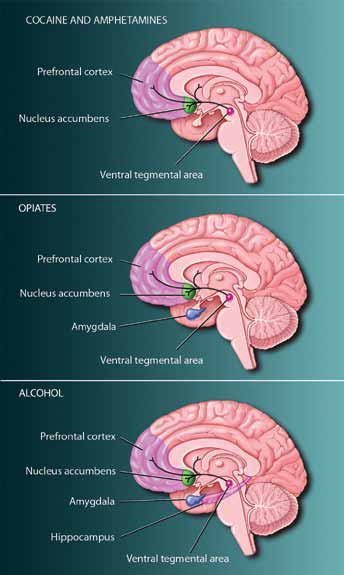
Here’s what each part is primarily responsible for—and guess what? As the pictures show, these are also the brain regions most affected by drugs of abuse:
Prefrontal cortex: This part is often referred to as the “CEO of the brain.” The prefrontal cortex is responsible for critical thinking and abstract thought, as well as many other functions like focusing attention, organizing thoughts, controlling impulses, and forming strategies for future action. The prefrontal cortex is one of the last regions of the brain to mature, so changes caused by drug abuse could have long-lasting effects.
Nucleus accumbens: Part of the so-called “pleasure center,” the nucleus accumbens is thought to play an important role in reward, pleasure, laughter, aggression, and fear.
Amygdala: Research shows that the amygdala has a major role in processing memory and emotional reactions, such as fear. The amygdala is part of the limbic system.
Hippocampus: Also part of the limbic system, the hippocampus plays important roles in moving information from short-term memory to long-term memory.
Ventral tegmental area: This structure is important in thinking, motivation, and intense emotions relating to love.
– Fair Fighting Rules
Creating and sticking to rules when having an argument is the key to maintaining healthy communication and finding sound resolution. Follow these rules to ensure safe arguments.
- Stick to the problem.
- Do not bring up things from the past.
- Argue to resolve, not to be right.
- Use “I feel” statements.
- Do not be accusatory.
- Do not take everything as a personal attack.
- Check in with each other.
- Do not let your tone escalate, breathe instead.
- Take time outs if you feel the argument is getting too heated or emotional.
- Listen to understand, not to respond or rebuttal.
- Do not freeze your partner out or shutdown. If you feel the need for space, ask for a time out.
- No yelling!
- No throwing objects, pushing, shoving, etc.
- No talking over each other.
Your Turn! Create of list of your fair fighting rules that you both agree are important to finding peace, resolution and healthy communication.
– Rebuilding Trust Information
Trust in an intimate relationship is rooted in feeling safe with another person. Infidelity, lies, or broken promises can severely damage the trust between partners. That, however, does not necessarily mean that a relationship can’t be salvaged. Although rebuilding trust can be challenging when there is a significant breach, it is, in fact, possible if both partners are committed to the process.
Picking up the Pieces
It takes time and effort to re-establish the sense of safety you need for a relationship to thrive and continue to grow. Recovery from the trauma caused by a break in the trust is where many couples who want to get back on track can get stuck.
Research has shown that couples must address the following five points in order to effectively move past a breach of trust:
- Knowing the details
- Releasing the anger
- Showing commitment
- Rebuilding trust
- Rebuilding the relationship
Whether you were the offending partner or the betrayed, to rebuild the trust and respect, both of you must renew your commitment to one another.
Know the Details
Even in seemingly clear-cut cases of betrayal, there are always two sides. The offending partner should be upfront and honest with information, in addition to giving clear answers to any and all questions from their partner.
This will give the betrayed party a broader understanding of the situation. What happened, when, and where? What feelings or problems may have contributed to this situation? What were the mitigating circumstances?
Release the Anger
Even minor breaches of trust can lead to mental, emotional, and physical health problems. Partners may have trouble sleeping or diminished appetite. They may become irritable over small things or be quick to trigger.
While it may be tempting to stuff all of the anger and emotions down, it is imperative that betrayed partners tune in and reflect on all the feelings that they have. Consider the impact of your partner’s betrayal on you and others.
Reflect on how life has been disrupted including thinking about all the questions and doubts that are now emerging. Make your partner aware of all these feelings.
Even the offending partner is encouraged to express any feelings of resentment and anger they may have been holding on to even before the incident.
Show Commitment
Both parties, especially the betrayed, may be questioning their commitment to the relationship and wondering if the relationship is still right for them or even salvageable.
Acts of empathy—sharing pain, frustration, and anger; showing remorse and regret; and allowing space for the acknowledgment and validation of hurt feelings—can be healing to both parties.
Defining what both sides require from the relationship can help give partners the understanding that proceeding with the relationship comes with clear expectations that each person, in moving ahead, has agreed to fulfill.
Both parties must work to define what is required to stay committed to making the relationship work.
In communicating this, avoid using words that can trigger conflict (e.g., always, must, never, should) in describing what you see, expect, or want from your spouse. Instead, choose words that facilitate open conversation and use non-blaming “I” statements. For example, favour “I need to feel like a priority in your life” over “You never put me first.”
Rebuilding Trust
Together, you must set specific goals and realistic timelines for getting your relationship back on track. Recognize that rebuilding trust takes time and requires the following:
- Decide to forgive or to be forgiven. Make a conscious decision to love by trying to let go of the past. While achieving this goal fully may take some time, committing to it is what’s key.
- Be open to self-growth and improvement. You can’t repair broken trust with just promises and statements of forgiveness. The underlying causes for the betrayal need to be identified, examined and worked on by both spouses for the issues to stay dormant.
- Be aware of your innermost feelings and share your thoughts. Leaving one side to obsess about the situation or action that broke the trust is not going to solve anything. Instead, it is important to openly discuss the details and express all feelings of anger and hurt.
- Want it to work. There is no place in the process for lip service or more lies. Be honest about and true to your wishes.
Once the above points have been taken to heart by both sides, talk openly about your goals and check in regularly to make sure you are on track.
– Relationship Conflict Resolution
Focus on the problem, not the person
When a disagreement turns to personal insult, raised voices, or mocking tones, the conversation is no longer productive. Be careful to focus on the problem without placing blame on your partner. If a disagreement becomes personal, you should pause the conversation.
Use reflective listening
Oftentimes during arguments we focus on getting our own point across rather than listening to our partner. Before responding to your partner, restate what they have said to you in your own words. Continue this process until your partner agrees that you understand. Next, share your side. Your partner should reflect back your ideas in their own words until they too understand. Using this technique will help both individuals feel listened to and understood, even if you disagree.
Use ”I” Statements
When sharing a concern, begin your sentence with “I”. For example: “I feel hurt when you don’t tell me you’ll be late”. With this sentence format we show that we are taking responsibility for our own emotions rather than blaming our partner. The alternative sentence – “You never tell me when you’re going to be late” – will often cause a partner to become defensive.
Know when to take a time-out
When you and your partner are becoming argumentative, insulting, or aggressive, it’s a good idea to take a time-out. Have a plan in place so you and your partner can call for a break when needed. Spend some time doing something alone that you find relaxing. When you’ve both calmed down, you and your partner can return to solving the problem. Be sure that you do return – it isn’t a good idea to leave these issues unaddressed.
Work toward a resolution
Disagreement is a normal part of a relationship. If it becomes clear that you and your partner will not agree, focus on a resolution instead. Try to find a compromise that benefits both individuals. Ask yourself it this disagreement really matters to your relationship, and let yourself move on if now.
B. Worksheets
– Anger Management Worksheets
– Anger Diary
– Anger Iceberg Worksheet
– Automatic Thoughts
– Basic Emotion Assessment
– Breathing Exercises
– Self-Esteem Sentence Stems Worksheet
– Triggers
C. Homework
D. YouTube
Your Brain on Stress and Anxiety
What Depression and Anxiety Look Like in the Brain
Change your Brain Chemistry- Alternatives to Medication- Neuroplasticity- Depression Skills
Hey folks, it’s Paras!
If you have a request to see a tech product, summary on personal development or want a custom design for clothing and merch … Please do let me know through the links below.

Join me or support my work
💌 Monthly email sign up for all posts
▶️ YouTube | TikTok | Instagram
👍 Facebook | X | Blog
🎤 Podcasts: My Stories | Self Growth
Other links:
☕ Buy me a Coffee
🛒 My Amazon
👕 My Merch